How Much Does WSIB Pay? Ontario Benefits Guide

If you were hurt at work, one of your first questions is probably simple: how much does WSIB pay while you recover? The answer depends on your income before the injury, whether you can still work in some way, the type of benefit you qualify for, and whether the WSIB has accepted all parts of your claim. This guide explains the main WSIB benefits in Ontario, how payments are calculated, and what to do if the amount seems too low.
Not sure if your WSIB payment is correct? Claim your benefits with help from a verified WSIB lawyer or paralegal.
Key Takeaways
- WSIB usually pays 85% of your net average earnings for Loss of Earnings benefits. Net average earnings means your average pay after probable deductions such as income tax, CPP, and EI.
- Your payment can be full or partial. If you cannot work at all because of the injury, you may receive full LOE benefits. If you can work but earn less, WSIB may pay 85% of the difference.
- WSIB benefits are not only wage loss payments. You may also qualify for health care benefits, Non-Economic Loss awards, return-to-work support, or survivor benefits.
- There is a maximum insurable earnings ceiling. For 2026, WSIB lists the maximum insurable earnings ceiling as $121,700, compared with $117,000 in 2025.
- Calculation mistakes happen. Missing overtime, second-job income, bonuses, or medical evidence can reduce what you receive.
What Types of Benefits Does WSIB Provide?
WSIB benefits are meant to support Ontario workers after a work-related injury or illness. The exact benefits you receive depend on what happened, how your injury affects your ability to work, and what medical evidence is in your file.
The most common WSIB benefits include:
- Loss of Earnings benefits: Wage replacement when your injury causes you to lose income.
- Health care benefits: Coverage for approved treatment and injury-related medical needs.
- Non-Economic Loss benefits: A payment for a permanent impairment caused by the workplace injury.
- Return-to-work support: Help with safe work duties, modified work, and work transition when needed.
- Survivor benefits: Financial support for eligible family members when a worker dies because of a work-related injury or disease.
If your claim has already been denied, the payment question becomes even more urgent. You may also want to read our guide on what to do when a WSIB claim is denied.
How WSIB Calculates Your Loss of Earnings Benefits
Loss of Earnings, often called LOE, is the main benefit that replaces part of your pay when a workplace injury affects your income. According to WSIB policy, LOE benefits are based on your net average earnings, not simply your gross wage.
For most accepted claims, the basic formula is:
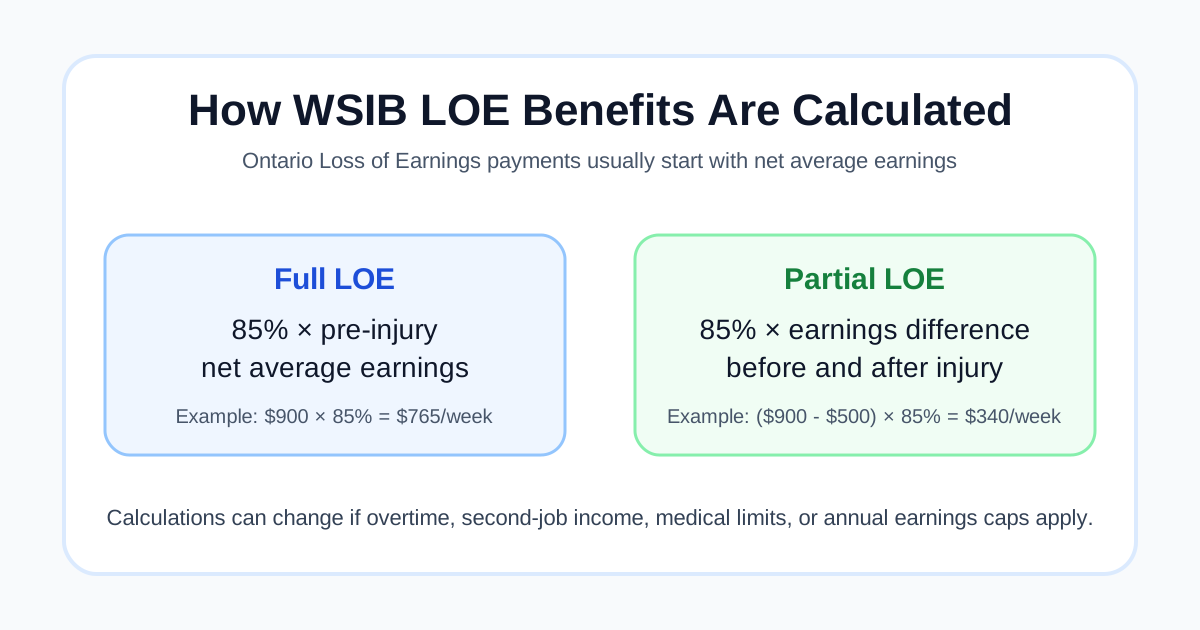
Full LOE benefit = 85% of your pre-injury net average earnings.
Net average earnings are calculated after probable deductions. WSIB policy says it applies deductions for income tax, Canada Pension Plan or Quebec Pension Plan premiums, and Employment Insurance premiums to reach net average earnings. These deductions are used for the benefit calculation. They are not the same as WSIB actually sending those amounts to the government.
Full LOE vs. partial LOE
You may receive full LOE benefits if your accepted work injury prevents you from working at all. For example, if your pre-injury net average earnings were $900 per week and you cannot work because of the injury, the full LOE amount would generally be 85% of $900, or $765 per week.
Partial LOE applies when you can work but earn less because of the injury. In that case, WSIB generally looks at the difference between your pre-injury net average earnings and your current net earnings or deemed earnings.
The simplified formula is:
Partial LOE benefit = 85% of the difference between pre-injury net earnings and post-injury net earnings.
For example, if your pre-injury net average earnings were $900 per week and you can only earn $500 per week in modified work, the difference is $400. A partial LOE payment would generally be 85% of that difference, or $340 per week.
What earnings does WSIB count?
The calculation can become complicated because your average earnings may include more than just your base hourly wage. WSIB policy on short-term average earnings lists items such as base pay, taxable tips, shift differentials, vacation pay paid with each paycheque, overtime, regular production bonuses, commissions, room and board when part of pay, and concurrent employment at the time of injury.
This matters because many workers receive less than they should when important income is missing from the calculation. If you regularly worked overtime, had a second job, earned commissions, or received shift premiums, those details may change the benefit amount.
If your LOE amount seems wrong, see our step-by-step guide on how to dispute WSIB LOE benefits.
Short-Term and Long-Term Average Earnings
WSIB does not always use the same earnings period for the whole claim. For accidents covered by current policy, short-term average earnings are generally used for the first 12 weeks of LOE benefits. WSIB describes short-term average earnings as the worker's earnings from the accident employer plus earnings from all other employment at the time of injury.
After that early period, WSIB may review long-term average earnings. This review can be important for workers whose income changes by season, overtime, commission, construction cycles, or irregular hours. A short four-week snapshot might not show what you usually earn over a longer period.
Here is the practical point: if your work pattern was not simple, do not assume the first calculation is final or fair. Gather pay stubs, T4s, employment contracts, commission records, overtime records, and proof of any other job you held when you were injured. These documents can help show what your real earnings were.
Non-Economic Loss Awards Explained
A Non-Economic Loss award, often called a NEL benefit, is different from Loss of Earnings. LOE replaces income. A NEL award recognizes a permanent impairment caused by your workplace injury or illness.
You may be considered for a NEL award when your condition has reached maximum medical recovery. That means your condition has stabilized and is not expected to improve much more with treatment. WSIB then looks at medical evidence and may arrange an assessment to rate the degree of permanent impairment.
NEL awards can apply to physical impairments, psychological impairments, or functional limits that remain after the injury. The payment is not based on whether you are working. A person may return to work and still receive a NEL award if the workplace injury caused a permanent impairment.
The amount depends on the impairment rating and WSIB's calculation rules. If you want a deeper explanation, read our guide to the WSIB NEL assessment process.
WSIB Health Care and Medical Benefits
WSIB may also pay for approved health care needed because of your work injury. These benefits can be just as important as wage replacement because treatment, medication, assistive devices, and rehabilitation can be expensive.
Health care benefits may include approved services such as:
- Doctor and specialist care
- Hospital care
- Physiotherapy or other approved therapy
- Prescription medication related to the workplace injury
- Medical equipment or assistive devices when approved
- Travel expenses for approved treatment in some situations
How Long Do WSIB Benefits Last?
There is no single answer for every claim. WSIB benefits can last for a short recovery period, months, years, or in some cases until age 65, depending on the benefit type and the facts of the claim.
LOE benefits may continue while your accepted work injury causes a loss of earnings. They can stop or change if WSIB decides you have recovered, can return to suitable work, are earning again, or could earn income in suitable work. Benefits may also be reviewed when your medical condition changes or when new earnings information becomes available.
NEL benefits are different because they relate to permanent impairment. Health care benefits can continue as long as WSIB accepts that the treatment is necessary and connected to the work injury. Survivor benefits follow separate rules for eligible spouses, dependants, and other family members.
If WSIB ends your benefits before you are ready, act quickly. Deadlines can be short, especially for return-to-work decisions. Our guide on how to appeal a WSIB Loss of Earnings decision explains the appeal steps and evidence to gather.
If your benefits were reduced, stopped, or calculated too low, start your ClaimIt intake and connect with a WSIB professional.
What Is the Maximum WSIB Payment in Ontario?
WSIB benefits are subject to a maximum insurable earnings ceiling. This ceiling limits the amount of earnings that can be insured for WSIB purposes. WSIB states that the maximum insurable earnings ceiling for 2026 is $121,700, compared with $117,000 in 2025.
This does not mean every worker can receive $121,700 from WSIB. It means WSIB will not calculate insured earnings above that ceiling for the year. Your actual benefit still depends on your own pre-injury earnings, the accepted impact of the injury, the 85% net earnings formula for LOE, and any other rules that apply to your claim.
Here is a simple way to think about it:
- If your earnings are below the annual ceiling, WSIB uses your applicable average earnings to calculate benefits.
- If your earnings are above the ceiling, WSIB generally caps the earnings used in the calculation at the maximum insurable amount.
- If you return to work at lower pay, WSIB may calculate partial LOE based on the difference between your pre-injury and post-injury earnings.
| WSIB payment question | Short answer |
|---|---|
| Full LOE benefits | Usually 85% of pre-injury net average earnings |
| Partial LOE benefits | Usually 85% of the difference between pre-injury and post-injury net earnings |
| Maximum insurable earnings | $121,700 for 2026, based on the WSIB annual ceiling |
| Health care benefits | Approved treatment costs tied to the accepted workplace injury |
| NEL awards | A separate payment for permanent impairment, not weekly wage replacement |
Survivor Benefits After a Fatal Workplace Injury
When a worker dies because of a work-related injury or occupational disease, WSIB may provide survivor benefits to eligible family members. These benefits can include payments to a spouse, dependent children, or other eligible dependants, as well as support for funeral and related expenses.
Survivor benefit claims can be emotionally difficult and legally complex. Families may need to prove the connection between the death and the workplace exposure or injury. This can be especially challenging in occupational disease cases, where the illness may appear years after the exposure.
If your family is dealing with this situation, our article on WSIB survivor benefits and legal help explains what to expect.
Why Injured Workers Often Receive Less Than They Deserve
Many injured workers assume WSIB will automatically have every document it needs. Unfortunately, claims often turn on missing details. A small gap in evidence can lead to a lower payment, a denied benefit, or a return-to-work decision that does not match your real limits.
Common reasons workers receive less include:
- Incomplete earnings records: Overtime, bonuses, tips, commissions, vacation pay, or second-job income may be missing.
- Weak medical evidence: Doctor notes may not clearly explain your work restrictions or connect them to the workplace injury.
- Unsuitable modified work: You may be offered duties that do not respect your medical limits, leading to reduced benefits if WSIB believes the work is suitable.
- Missed deadlines: Waiting too long to object can make it harder to challenge a decision.
- Understated permanent impairment: A NEL rating may not reflect the full impact of the injury.
- Communication problems: Phone calls, letters, and forms can be misunderstood or missed during recovery.
How to Check Whether Your WSIB Payment Looks Right
You do not need to become a WSIB expert to spot possible problems. Start with a basic review of the decision letter and payment details.
- Find the earnings figure WSIB used. Compare it to your pay stubs, T4, overtime, bonuses, and second-job income.
- Check whether the decision uses gross or net language. LOE is based on net average earnings after probable deductions, not just gross pay.
- Look for the period used to average your earnings. Ask whether the period is fair if your income was seasonal, irregular, or commission-based.
- Compare the medical restrictions to your real job duties. A return-to-work plan should match what your doctor says you can safely do.
- Mark the objection deadline. Do this as soon as you receive a decision you disagree with.
You do not have to figure this out alone. Use ClaimIt to choose a verified WSIB lawyer or paralegal who can review your benefits and explain your options.
FAQ: WSIB Benefits and Payments
If you are worried your WSIB payment is too low, compare verified WSIB lawyers and paralegals who can review your calculation and help you dispute it.
How much does WSIB pay for lost wages?
WSIB generally pays 85% of your pre-injury net average earnings for full Loss of Earnings benefits. If you can work but earn less because of your injury, WSIB may pay 85% of the difference between your pre-injury and post-injury net earnings.
Does WSIB pay 100% of my wages?
No. LOE benefits are generally based on 85% of net average earnings. Because the calculation uses net earnings after probable deductions, the amount is not the same as 100% of your gross wage.
What is included in WSIB average earnings?
Depending on your situation, average earnings may include base pay, overtime, regular bonuses, commissions, shift differentials, taxable tips, vacation pay paid with each paycheque, and income from other jobs you had at the time of injury.
Can WSIB pay for medical treatment?
Yes. WSIB may pay for approved health care that is necessary and related to your accepted workplace injury or illness. This can include doctor care, therapy, medication, equipment, and other approved treatment needs.
Can I get WSIB if I go back to work part time?
Yes, you may still qualify for partial LOE benefits if your accepted injury causes you to earn less than before. WSIB generally looks at the difference between your pre-injury and post-injury earnings.
What if WSIB calculated my benefits wrong?
You can ask WSIB to explain the calculation and you may be able to object to the decision. Gather your earnings records, medical evidence, and decision letters as soon as possible because appeal deadlines apply.
Final Thoughts
WSIB benefits can provide critical support after a workplace injury, but the calculations are not always simple. The 85% LOE formula is only the starting point. Your actual payment can depend on overtime, second jobs, net earnings deductions, medical restrictions, return-to-work decisions, permanent impairment ratings, and annual maximum earnings limits.
If you are worried your payment is too low, trust that concern enough to investigate it. Review the numbers, keep your documents, and get advice before the deadline passes. ClaimIt connects injured workers in Ontario with verified WSIB lawyers and paralegals who understand how to challenge unfair decisions and help workers pursue the benefits they deserve.
Need Help With Your WSIB Claim?
Connect with a verified WSIB lawyer or paralegal in Ontario. Most offer free consultations and work on contingency.
Find a Representative