What to Do When Your WSIB Claim Is Denied

Getting a letter that says your WSIB claim has been denied is devastating. You are already dealing with pain, lost income, and stress, and now the system you counted on has turned you away.
Find a verified WSIB representative on ClaimIt to review your denial for free. Most offer no-cost consultations and work on contingency, so you pay nothing unless you win.
Take a breath. A denial is not the end of the road. Thousands of Ontario workers successfully appeal WSIB decisions every year, and you may have strong grounds to do the same.
This guide explains why WSIB claims get denied, the exact steps you can take to fight back, and the deadlines you absolutely cannot miss. For a detailed appeal walkthrough, also see our guide on detailed appeal steps for Ontario.
Why Was Your WSIB Claim Denied?
Summary: WSIB denies claims for five main reasons: insufficient medical evidence, late reporting, employer disputes, pre-existing conditions, and inconsistent documentation. Understanding which reason applies to your case is the key to building a successful appeal.
Understanding the reason behind your denial is the first step toward overturning it. The Workplace Safety and Insurance Board processes tens of thousands of claims every year, and denials are more common than most workers realize. For a deeper look at each reason and how to counter it, read our guide to the top reasons WSIB claims get denied. Here are the most common reasons WSIB rejects claims:
1. Insufficient Medical Evidence
This is the number one reason for WSIB denials. If your medical records do not clearly connect your injury or illness to your job, WSIB may reject your claim. For example, if your doctor wrote that you have a back injury but did not specifically state it was caused by your work duties, that gap in documentation can lead to a denial.
WSIB adjudicators rely heavily on medical evidence when making decisions. They need to see a clear, documented connection between your workplace activities and your condition. General statements like "the patient has back pain" are not enough.
What you can do: Ask your doctor to provide a detailed medical report that explicitly links your condition to your workplace activities, tasks, or exposures. The report should describe your specific job duties and explain how those duties caused or contributed to your injury.
2. Late Reporting
Ontario law requires you to report a workplace injury to your employer as soon as possible. If there is a significant delay between when the injury happened and when you reported it, WSIB may question whether it was truly work-related.
This is especially common with repetitive strain injuries and occupational illnesses that develop gradually. Workers often do not realize the severity of their condition until weeks or months after symptoms first appear.
What you can do: Even if you reported late, provide a written explanation for the delay. Legitimate reasons, such as not realizing the severity of the injury at first or being unaware that a condition was work-related, can be accepted by WSIB.
3. Your Employer Disputed the Claim
Employers have the right to contest your WSIB claim. They may argue that the injury happened outside of work, that you had a pre-existing condition, or that your job duties could not have caused the injury. WSIB considers employer input when making decisions, and a strong employer objection can influence the outcome.
What you can do: Gather witness statements from coworkers, incident reports, and any other evidence that supports your version of events. If the injury happened on the job site, photos and safety reports can also help.
4. Pre-Existing Conditions
If WSIB determines that your symptoms are related to a condition you had before the workplace incident, they may deny your claim. However, Ontario law recognizes that work can aggravate a pre-existing condition, and you may still be entitled to benefits in that situation.
This is one of the most misunderstood areas of WSIB claims. Many workers assume that having a pre-existing condition automatically disqualifies them, but that is not the case. If your work made a pre-existing condition significantly worse, you have a valid claim.
What you can do: Get medical evidence showing how your workplace activities worsened your pre-existing condition beyond its natural progression. A specialist's opinion can carry significant weight in these cases.
5. Inconsistent Information
If your claim form, your employer's report, and your doctor's notes describe the injury differently, WSIB may see red flags. Consistent documentation from all parties is essential for a successful claim.
What you can do: Review all documents before they are submitted to make sure the details align regarding what happened, when, and how. Small discrepancies in dates, locations, or descriptions of the incident can create unnecessary problems.
Your Right to Appeal: Understanding the Process
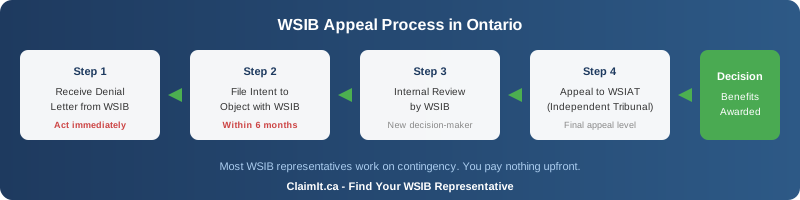
Summary: Ontario workers have a two-level appeal process. First, request an internal review through WSIB. If that fails, appeal to the independent WSIAT tribunal. You have the right to legal representation at both stages, and most representatives charge nothing upfront.
If your WSIB claim is denied, you have the legal right to challenge that decision. The appeal process in Ontario has two main levels. If you are also trying to understand what benefits you may be missing while the claim is denied, read our guide to how much WSIB pays in Ontario.
Level 1: Internal Review (Objection to WSIB)
The first step is to file an Intent to Object form directly with the WSIB. This asks a different decision-maker within WSIB to review your case with fresh eyes.
Here is how it works:
- Get the Intent to Object form from the WSIB website or by calling them at 1-800-387-0750
- Complete and submit the form within the time limit (see deadlines below)
- The front-line decision maker reconsiders your case and may request additional information
- If the decision is not changed, you will receive an Appeal Readiness Form to proceed to a full appeal hearing
Level 2: WSIAT Appeal (Workplace Safety and Insurance Appeals Tribunal)
If the internal review does not overturn the denial, you can appeal to the WSIAT, which is an independent tribunal separate from the WSIB. For a complete walkthrough, see our guide on how to appeal a WSIB decision. The WSIAT is the final level of appeal for workplace safety and insurance matters in Ontario.
At the WSIAT, your case will be heard by an independent adjudicator who was not involved in the original decision. You can present evidence, call witnesses, and have legal representation argue your case. The WSIAT hearing is more formal than the internal review and is your best opportunity to present a comprehensive case.
Having a WSIB paralegal or lawyer represent you at the WSIAT level is strongly recommended, as the process involves legal arguments and evidentiary rules that can be difficult to navigate alone.
Critical Deadlines You Cannot Miss
Summary: You have 6 months to object to most WSIB decisions and only 30 days for return-to-work or re-employment decisions. Missing these deadlines can permanently cost you your right to appeal.
The Workplace Safety and Insurance Act (Section 120) sets strict time limits for objecting to WSIB decisions. Missing these deadlines can cost you your right to appeal:
| Type of Decision | Time Limit to Object |
|---|---|
| Return-to-work decisions | 30 days |
| Re-employment decisions | 30 days |
| All other WSIB decisions (including claim denials) | 6 months |
If you have missed the deadline, WSIB may still extend the time limit in certain circumstances. Factors they consider include whether you had a reasonable explanation for the delay and whether your employer would be prejudiced by a late appeal. Contact a WSIB lawyer or paralegal immediately to discuss your options if you are close to or past a deadline.
Why Professional Representation Matters
Summary: WSIB appeals involve complex legal procedures, strict deadlines, and detailed evidence requirements. Licensed WSIB lawyers and paralegals understand the system and significantly improve your chances of a successful outcome. Most work on contingency, meaning you pay nothing unless you win.
You have the right to represent yourself in a WSIB appeal, but the process is complex, and the stakes are high. Understanding your workers' compensation rights can help you know what you are entitled to. Here is why hiring a WSIB lawyer or paralegal can make a significant difference:
- They know the system inside and out. WSIB has its own policies, procedures, and legal framework. Experienced representatives understand how decisions are made and what evidence carries the most weight. Some ClaimIt representatives are former WSIB insiders who spent decades working within the system.
- They handle the paperwork. Appeals involve detailed forms, medical reports, legal submissions, and strict deadlines. A representative manages all of this so you can focus on your recovery.
- They can identify issues you might miss. An experienced advocate may spot entitlements you did not know you had, such as benefits for Loss of Earnings (LOE), Non-Economic Loss (NEL), or secondary conditions related to your original injury.
- Most work on contingency. Many WSIB lawyers and paralegals in Ontario charge on a contingency fee basis, typically around 30% of your settlement. Learn more about what a WSIB lawyer costs in our detailed fee guide. This means you pay nothing upfront, and they only get paid if you win.
Steps to Take Right Now
Summary: If your WSIB claim was just denied, follow these five steps: read the denial letter carefully, gather evidence immediately, consult a WSIB specialist for free, keep records of everything, and file your Intent to Object before the deadline.
If your WSIB claim has just been denied, here is your action plan:
- Read the denial letter carefully. Understand exactly why your claim was denied and note the deadline to appeal. The specific reason for denial will determine your strategy going forward.
- Do not wait. Start gathering additional medical evidence and documentation immediately. The sooner you begin, the better your chances of a successful appeal.
- Talk to a WSIB specialist. Most WSIB lawyers and paralegals offer free consultations. They can review your denial and tell you whether you have grounds to appeal. Submit an intake form on ClaimIt to get connected quickly.
- Keep records of everything. Save all WSIB correspondence, medical reports, and any communication with your employer about your injury. Organize these documents chronologically.
- File your Intent to Object before the deadline expires. Even if you are still gathering evidence, getting the objection on file preserves your right to appeal.
How ClaimIt Can Help
At ClaimIt, we connect injured Ontario workers with verified WSIB lawyers and paralegals who specialize in exactly these situations. Our platform is completely free for workers to use.
Here is how it works:
- Browse our directory of 14+ verified WSIB specialists
- Compare experience levels, areas of focus, and fee structures
- Click "Choose" on your preferred representative and fill out a quick intake form
- Your chosen representative reviews your case and reaches out to discuss next steps
Find a WSIB representative now and get your free consultation
Frequently Asked Questions
Can I still appeal if I missed the deadline?
Possibly. WSIB can extend time limits in certain circumstances, such as when there is a reasonable explanation for the delay. Contact a WSIB representative as soon as possible to discuss your options.
How much does it cost to appeal a WSIB decision?
Many WSIB lawyers and paralegals work on a contingency fee basis, meaning you pay nothing upfront. They typically charge around 30% of your settlement amount, and you only pay if they win your case.
How long does a WSIB appeal take?
The timeline varies depending on the complexity of your case and the level of appeal. An internal review with WSIB can take several weeks to months. A WSIAT appeal may take longer, depending on hearing availability and the evidence involved.
What is the difference between a WSIB lawyer and a paralegal?
Both are licensed by the Law Society of Ontario to represent you in WSIB matters. Paralegals can represent you at WSIB and WSIAT hearings. Lawyers can do the same and can also represent you in court if your case goes to judicial review. Compare WSIB lawyers and paralegals on ClaimIt to find the right fit for your situation.
What evidence do I need for my appeal?
The most important evidence includes detailed medical reports linking your condition to your work, witness statements from coworkers, incident reports, and any correspondence with your employer about the injury. Your representative can help you identify exactly what is needed for your specific case.
Can my employer fire me for filing a WSIB claim?
No. Under Ontario's Workplace Safety and Insurance Act, employers are prohibited from retaliating against workers who file WSIB claims. If you believe your employer has penalized you for filing a claim, contact us to discuss your situation with a representative who can advise you on your rights.
Disclaimer: This article provides general information about the WSIB appeal process in Ontario and is not legal advice. For guidance specific to your situation, consult with a licensed WSIB lawyer or paralegal. ClaimIt is a directory platform that connects workers with legal representatives and is not a law firm.
Need Help With Your WSIB Claim?
Connect with a verified WSIB lawyer or paralegal in Ontario. Most offer free consultations and work on contingency.
Find a Representative