WSIB Objection Form Deadline: What to Know
If you disagree with a WSIB decision, the deadline on your decision letter matters. Missing the WSIB objection form deadline can make an already stressful claim feel even harder, especially if your benefits, return-to-work plan, or medical treatment are on the line.
Worried about a WSIB deadline? Compare verified WSIB lawyers and paralegals in Ontario through ClaimIt and find someone who can review your next steps.
This guide explains the Intent to Object form in plain language. You will learn the main WSIB objection deadlines, what information to include, common deadline mistakes, and what to do if you are close to the deadline or already past it. This is general information, not legal advice.
Quick Answer: What Is the WSIB Objection Form Deadline?
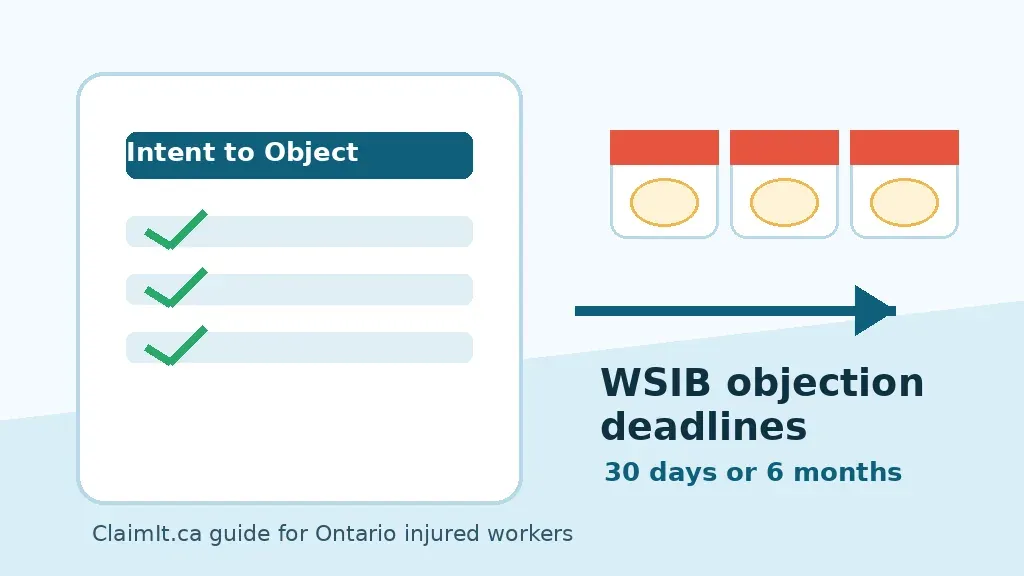
For most WSIB claim decisions, you have up to six months to object. For return-to-work, work transition, and re-employment decisions, you usually have up to 30 calendar days to object. Your WSIB decision letter should tell you the deadline that applies.
To meet the deadline, WSIB must receive your Intent to Object form before the time limit in the decision letter. Sending it late, sending it to the wrong place, or waiting until you have every piece of evidence can put your appeal rights at risk.
WSIB says that if a decision involves two issues with different time limits, such as a return-to-work issue and a loss-of-earnings issue, it will default to the six-month time limit. Even so, do not assume. Read the letter carefully and act quickly.
| Type of WSIB decision | Usual objection deadline | What to check |
|---|---|---|
| Return-to-work decision | 30 calendar days | The date and deadline printed in the decision letter |
| Work transition decision | 30 calendar days | Whether the issue relates to suitable work, retraining, or re-employment |
| Re-employment decision | 30 calendar days | Whether WSIB says your employer met its obligations |
| Most other claim decisions | Six months | Loss of earnings, health care, entitlement, NEL, and other benefit issues |
What Is the Intent to Object Form?
The Intent to Object form is the form workers use to tell WSIB they disagree with a decision and want to keep their right to appeal. WSIB also says it may accept a letter of objection, but the form is the clearest way to make sure the right details are included.
The form does not need to be a full legal argument. Its main job is to identify the decision you disagree with, explain the issue, and tell WSIB that you want the decision reviewed. You may add reasons and supporting information, but you should not miss the deadline because you are waiting for perfect evidence.
Think of the form as the first formal step. After WSIB receives it, the decision-maker may reconsider the decision. If the decision does not change, WSIB can send your claim file and the Appeal Readiness form so you can decide whether to move forward.
Where Do You Find the Deadline?
Start with the WSIB decision letter. Do not rely on memory, a phone call, or a general rule you found online. The decision letter should state the decision date, the issue decided, the reasons for the decision, and the deadline to object.
Look for these details right away:
- The date of the decision. This helps you identify the exact decision you are objecting to.
- The objection deadline. This is the date WSIB must receive your objection.
- The issue decided. For example, loss-of-earnings benefits, return to work, health care, entitlement, or a non-economic loss assessment.
- The decision-maker. This is usually the person you contact first if you want to ask for reconsideration.
If you cannot find the deadline or do not understand the issue, contact WSIB quickly and ask for clarification. You can also speak with a WSIB representative, lawyer, or paralegal before the deadline expires.
Do You Have 30 Days or Six Months?
The difference between 30 days and six months is one of the biggest risks in WSIB objections. Many workers assume they have six months for every decision. That is not always true.
When the 30-day deadline may apply
The 30-day deadline usually applies to decisions about return to work, work transition, and re-employment. These decisions can move fast because they affect whether you are expected to return to a job, accept modified duties, take part in a work transition plan, or deal with an employer re-employment issue.
Examples may include decisions about suitable work, cooperation in return-to-work planning, work transition services, or whether an employer met its re-employment obligations. If your letter mentions return to work, work transition, or re-employment, treat it as urgent.
When the six-month deadline may apply
The six-month deadline usually applies to other WSIB claim decisions. This can include decisions about initial entitlement, loss-of-earnings benefits, health care treatment, recurrence, permanent impairment, non-economic loss awards, or whether a condition is related to the workplace injury.
Even with a six-month deadline, waiting is risky. Medical records can take time to gather, witnesses may become harder to reach, and your own notes may become less detailed. Starting early gives you more room to correct errors before the appeal moves forward.
What Should You Include on the WSIB Objection Form?
Your objection should be clear, specific, and easy for WSIB to match to the right decision. You do not need to write like a lawyer. You do need to explain what you disagree with and why.
Include these basics:
- Your name, claim number, and contact information. Make sure WSIB can identify your file.
- The date of the decision you are objecting to. If there is more than one decision, list each decision date.
- The specific issue you disagree with. Do not write only that you disagree with everything. Name the benefit, treatment, return-to-work issue, or entitlement issue.
- The outcome you want. For example, approval of the claim, reinstatement of loss-of-earnings benefits, coverage for treatment, or a different return-to-work decision.
- Your reasons. Briefly explain what you believe WSIB missed, misunderstood, or weighed incorrectly.
- Any new or important information. Mention medical reports, work restrictions, wage records, job duties, witness information, or other documents that support your position.
If someone is helping you, such as a lawyer, paralegal, union representative, family member, or friend, make sure the right authorization is in place. WSIB requires written authorization before a representative can access your claim file.
Should You Ask for Reconsideration Before Filing the Form?
WSIB encourages workers to contact the decision-maker first, explain why they disagree, and ask for reconsideration. In some cases, a decision can be changed before a formal appeal moves further. That can save time and stress.
But reconsideration should not cause you to miss the WSIB objection form deadline. If the deadline is getting close, submit the Intent to Object form on time. You can still provide more information after that, and the decision-maker may still review the file.
If your claim was denied and you are still deciding what to do, read ClaimIt's guide on getting help after a denied WSIB claim. If you are already in the appeal stage, the broader WSIB appeal process guide explains what can happen after the objection is filed.
Common Deadline Risks That Hurt Workers
Most deadline problems are not caused by workers ignoring their claims. They happen because the process is confusing, the worker is injured, and important letters arrive while the worker is dealing with pain, income loss, treatment, or pressure to return to work.
Waiting for medical records before objecting
It is natural to want every report before you send the form. But the deadline is about preserving your right to object. If records are delayed, you can submit the form first and explain that more evidence will follow.
Assuming every decision has a six-month deadline
Return-to-work and work transition decisions can have much shorter deadlines. If you see a 30-day deadline, treat it as urgent and get help quickly if you are unsure.
Objecting to the wrong decision
Some workers receive several letters in a short period. Each decision can have its own deadline. Use the decision date and issue from the letter so WSIB knows exactly what you are challenging.
Sending a vague objection
A vague objection can slow the process. Instead of saying only, "I disagree," explain the part of the decision you disagree with. For example, you might say you disagree that your current restrictions are not related to the workplace injury, or you disagree that the modified job is suitable.
Missing mail or email from WSIB
If WSIB does not have your current address, phone number, or email, you may miss a decision letter or appeal document. Update your contact information right away if anything changes.
Need a second set of eyes before you send the form? Find a WSIB lawyer in Ontario or compare WSIB paralegals through ClaimIt.
What If You Are Close to the Deadline?
If the deadline is days away, focus on protecting your right to object. You can improve the details later, but you may not be able to fix a missed deadline easily.
Take these steps:
- Read the decision letter again. Confirm the decision date, issue, and deadline.
- Complete the Intent to Object form as clearly as you can. Identify the decision and explain the main reason you disagree.
- Submit it through a method you can prove. Keep confirmation, copies, fax records, upload receipts, or any other proof of submission.
- Tell WSIB if more evidence is coming. List the records you are waiting for, such as medical reports or employer documents.
- Get advice quickly if the issue is serious. This is especially important if benefits have stopped or return-to-work obligations are involved.
Do not wait until the last hour if you can avoid it. Technical problems, missing claim numbers, or confusion about the form can become much more stressful on the final day.
What If You Missed the WSIB Objection Form Deadline?
If you missed the deadline, do not assume your case is over. WSIB says that if you still want to object, you must send a letter to the decision-maker asking for an extension and explaining why you missed the time limit. WSIB will write back to tell you whether it can extend the time limit.
Your extension request should be honest, specific, and supported where possible. Explain what happened and why you could not object on time. If illness, hospitalization, mental health symptoms, language barriers, lack of notice, mail problems, or missing information affected you, say so clearly.
Include:
- The decision date and issue you want to object to
- The original deadline, if you know it
- The reason you missed the deadline
- When you learned about the missed deadline
- What steps you took once you realized there was a problem
- Any documents that support your explanation
If you are past the deadline, it can be especially helpful to speak with someone who handles WSIB objections. The extension request may affect whether your appeal can move forward.
What Happens After You Submit the Intent to Object?
After WSIB receives your Intent to Object form, the decision-maker may review the decision again. If you provide new information, WSIB says this reconsideration step generally takes about 14 business days.
If the decision changes, you may not need to continue with a formal appeal on that issue. If the decision does not change, WSIB can send you a copy of your claim file, an Appeal Readiness form, and instructions for the next stage.
At that point, review the claim file carefully. Check whether important medical reports, job descriptions, wage details, accident reports, or correspondence are missing. If something important is missing, tell WSIB and provide it if you can.
The appeal process can become more detailed after this stage. You may need to organize evidence, prepare submissions, respond to the employer's position, and decide whether you want representation. ClaimIt's guide on how to appeal WSIB covers the larger process.
When Should You Consider a WSIB Lawyer or Paralegal?
You are allowed to handle a WSIB objection on your own. Some workers do. But there are situations where getting help early can reduce risk.
Consider speaking with a WSIB lawyer or paralegal if:
- Your benefits have been denied, reduced, or stopped
- You are close to the deadline or already missed it
- The decision involves return to work, suitable duties, or work transition
- Your medical evidence is complicated or incomplete
- Your employer disputes the claim or offers a different version of events
- You have more than one decision letter and are unsure what to object to
- You are dealing with a serious injury, chronic pain, psychological injury, or permanent impairment
ClaimIt is a marketplace, not a law firm. The platform helps injured workers compare verified WSIB lawyers and paralegals in Ontario, review experience and fee information, and choose a representative to contact. Many representatives offer free consultations, and many WSIB matters are handled through contingency fee arrangements where fees are paid only if the case succeeds.
If a WSIB decision is affecting your income, treatment, or return to work, compare WSIB lawyers and paralegals on ClaimIt before the deadline passes.
WSIB Objection Form Checklist
Before you submit the form, use this checklist:
- I found the decision letter and deadline.
- I confirmed whether the deadline is 30 days or six months.
- I listed the correct decision date.
- I identified the specific issue I disagree with.
- I explained the outcome I want.
- I added the strongest reasons I disagree with the decision.
- I noted any evidence that is attached or still coming.
- I kept a copy of the form and proof of submission.
- I updated my contact information with WSIB if needed.
- I asked for help if the deadline, issue, or evidence is unclear.
FAQ: WSIB Objection Form Deadlines
What is the deadline to object to a WSIB decision?
Most WSIB claim decisions have a six-month objection deadline. Return-to-work, work transition, and re-employment decisions usually have a 30-day deadline. Always check the deadline printed in your decision letter.
Does WSIB have to receive the form before the deadline?
Yes. WSIB says it must receive your Intent to Object form before the time limit set out in the decision letter. Keep proof of when and how you submitted it.
Can I submit the Intent to Object form before I have all my evidence?
Yes. If the deadline is close, it is usually safer to submit the form on time and explain that more evidence will follow. Waiting for records can create deadline problems.
What if I missed the WSIB objection deadline?
You can send a letter to the decision-maker asking for an extension and explaining why you missed the deadline. WSIB will tell you whether it can extend the time limit.
Do I need a lawyer or paralegal to file the form?
No. You can file the form yourself. But a WSIB lawyer or paralegal may help if the deadline is close, the issue is serious, benefits have stopped, or the evidence is complicated.
Next Step: Protect Your Deadline First
A WSIB objection does not need to be perfect on day one. It does need to be on time. Read your decision letter, confirm the deadline, submit the Intent to Object form before the time limit expires, and keep proof that WSIB received it.
If you are unsure what to object to, how to explain the issue, or what to do after a missed deadline, do not wait. A short conversation with a WSIB professional can help you understand your options before the appeal moves further.
Ready to compare options? Visit ClaimIt's WSIB lawyer and paralegal directory to choose a verified Ontario representative.
Need Help With Your WSIB Claim?
Connect with a verified WSIB lawyer or paralegal in Ontario. Most offer free consultations and work on contingency.
Find a Representative