Healthcare Worker WSIB Claims in Ontario
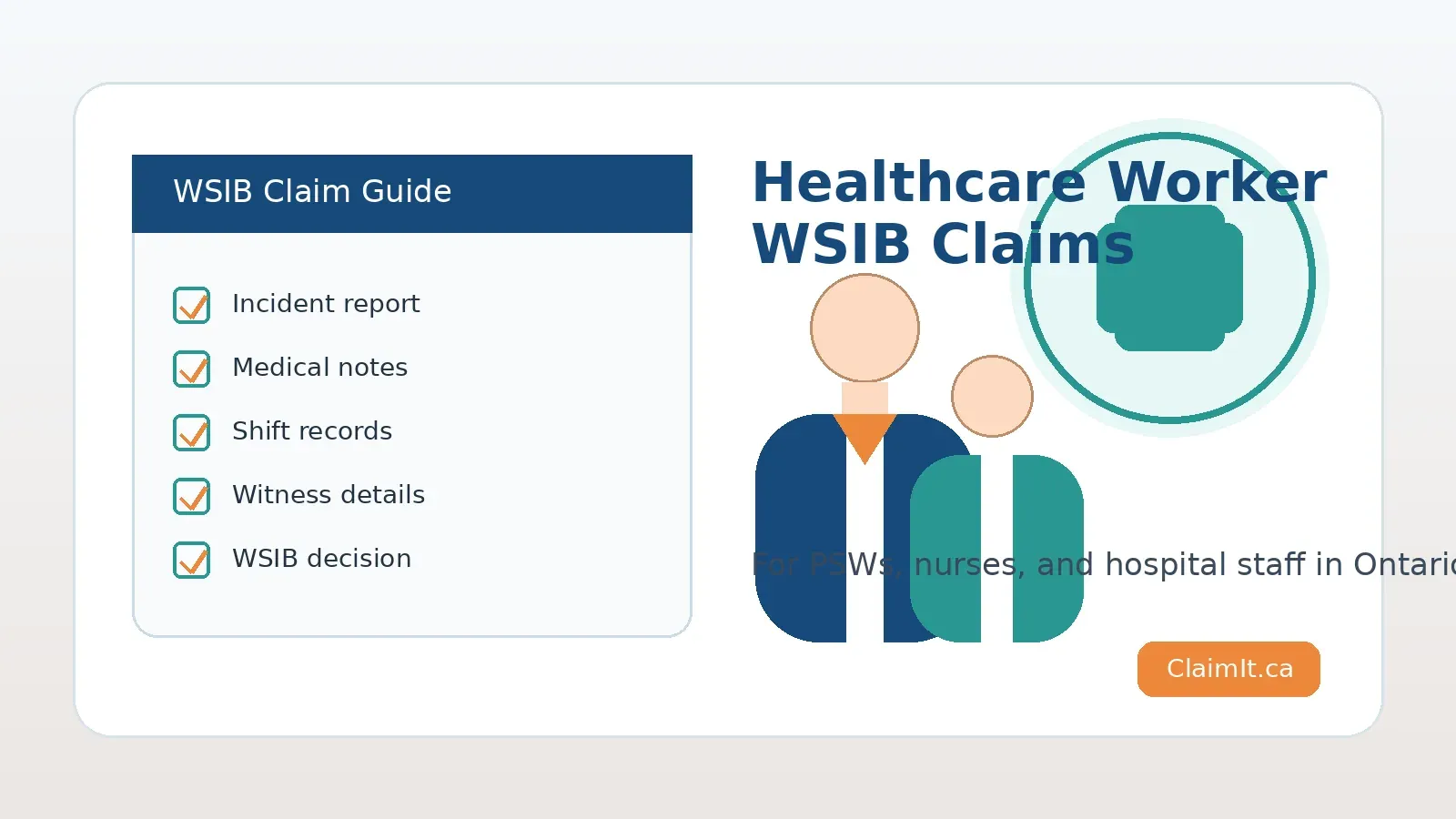
A healthcare worker WSIB claim in Ontario can involve much more than one obvious accident. Personal support workers, nurses, hospital porters, cleaners, lab staff, developmental support workers, and long-term care employees often face injuries from lifting, patient handling, violence, psychological trauma, slips, needle exposure, and infectious illness. The hard part is not always knowing you were hurt at work. The hard part is proving the connection clearly enough for WSIB to accept the claim and pay the right benefits.
Find a verified WSIB lawyer or paralegal on ClaimIt if your healthcare worker claim was denied, delayed, or reduced.
This guide explains the common WSIB issues healthcare workers face in Ontario, what evidence can help, and when it may be time to get advice from a representative. It is general information, not legal advice.
Why healthcare worker WSIB claims need careful evidence
Healthcare work is physically and emotionally demanding. Many injuries happen during routine tasks, such as transferring a resident, repositioning a patient, responding to aggressive behaviour, rushing between rooms, or cleaning contaminated areas. Because these tasks are part of the job, some workers assume WSIB will automatically understand what happened. That is a risky assumption.
WSIB usually needs a clear link between your job duties and your injury or illness. For a single accident, that may mean showing the date, time, task, body part, and immediate symptoms. For a gradual injury, it may mean showing how repeated job duties caused or significantly contributed to the condition. For mental stress or infectious exposure, the evidence can be even more specific.
Ontario's health care sector has a high volume of allowed lost-time injuries. Ontario government sector trend data reported 14,800 lost-time injuries in health care and social assistance in 2024, with major categories including exposures, musculoskeletal disorders, falls, workplace violence, and contact with objects. That does not mean every claim is approved. It means healthcare workers should document their claims carefully because WSIB sees many different injury patterns in this sector.
Common WSIB claim types for PSWs, nurses, and hospital staff
Healthcare workers can file WSIB claims for both sudden incidents and injuries that develop over time. The strongest evidence depends on the type of claim.
Overexertion, lifting, and patient handling injuries
PSWs, nurses, orderlies, and long-term care staff often suffer back, shoulder, neck, wrist, and knee injuries while lifting, transferring, bathing, repositioning, or catching a patient who is falling. These claims may involve a single event, such as a sudden pull in the lower back during a two-person transfer, or a gradual problem caused by repeated heavy care duties.
Useful evidence may include shift notes, resident care plans, transfer requirements, staffing levels, lift equipment availability, incident reports, witness names, and medical notes that connect the body part to the work task. If the injury developed over time, write down the specific duties that aggravated it, how often they occurred, and when symptoms first became difficult to ignore.
If pain continues after the original injury, WSIB may question whether the ongoing symptoms are still related to work. Our guide to WSIB chronic pain claims in Ontario explains how continuing pain evidence is often assessed.
Workplace violence and assault injuries
Healthcare workers may be hit, kicked, bitten, grabbed, threatened, spat on, or injured while intervening in a behavioural crisis. These incidents can cause physical injuries, psychological injuries, or both. They can happen in hospitals, long-term care homes, group homes, home care settings, emergency departments, and mental health units.
Document the event as soon as possible. Include what the patient, resident, client, visitor, or other person did, where it happened, who saw it, whether security or police were involved, and what symptoms appeared afterward. If the incident caused fear, panic, sleep problems, flashbacks, anxiety, depression, or avoidance of work areas, tell a medical professional early and ask that it be recorded.
For mental health effects after a violent or traumatic event, WSIB may look at whether there is a diagnosed psychological injury and whether the traumatic event arose out of and in the course of employment. ClaimIt's guide to WSIB psychological injury claims in Ontario explains the mental stress claim categories in more detail.
Psychological injuries from repeated work stressors
Not every psychological injury comes from one sudden assault. Some healthcare workers develop anxiety, depression, post-traumatic stress symptoms, or other diagnosed conditions after repeated exposure to threats, harassment, bullying, understaffing pressures, patient aggression, or traumatic events.
WSIB chronic mental stress claims can be difficult because the worker must usually show a substantial work-related stressor and a proper diagnosis. General frustration with work is usually not enough. A strong record may include incident logs, emails, complaint records, staffing records, witness information, medical notes, counselling records, and a timeline showing when symptoms started and what work events contributed.
Infectious exposure and communicable illness claims
Healthcare workers can face exposure to infectious illness through patient care, personal care, emergency response, contaminated surfaces, body fluids, sharps, and other workplace sources. WSIB's communicable illness policy says a worker may be entitled to benefits when a communicable illness arises out of and in the course of employment, and when the employment made a significant contribution to contracting the illness.
For infectious exposure claims, WSIB may compare work and non-work exposure risks. Helpful evidence can include known outbreaks, patient assignments, unit records, PPE issues, exposure reports, testing dates, symptom onset dates, medical confirmation, and information about whether the worker had similar exposure outside work. The claim is usually stronger when the timeline and exposure source are specific.
For related illness issues, see our guide to WSIB occupational disease claims in Ontario.
Slips, falls, needle injuries, and contact injuries
Hospital and care settings also create risks from wet floors, cords, equipment, crowded rooms, sharp objects, carts, medication rooms, laundry areas, and parking lots. These claims may seem straightforward, but details still matter. Report the hazard, photograph it if safe, identify witnesses, and get medical care quickly. If you delay reporting, WSIB may ask why the injury was not documented earlier.
What should you do right after a healthcare workplace injury?
Fast, accurate steps can protect your claim. The goal is to create a consistent record across your employer, your health provider, and WSIB.
- Get medical attention. Tell the doctor, nurse practitioner, emergency department, clinic, or therapist that the injury or illness is work-related. Name the task or exposure that caused it.
- Report the injury to your employer. Follow the workplace reporting process. Ask for a copy or confirmation of the incident report when possible.
- Write your own timeline. Include the date, time, location, task, body part, symptoms, witnesses, supervisor notified, and any equipment or staffing issue.
- Keep copies of records. Save emails, schedules, modified work offers, medical notes, WSIB letters, prescriptions, treatment plans, and missed-work dates.
- File or confirm the WSIB paperwork. If you are unsure how the process starts, read our guide on how to file a WSIB claim in Ontario.
Need help reviewing a denied or complicated healthcare worker WSIB claim? ClaimIt can help you compare Ontario WSIB representatives.
Evidence checklist for healthcare worker WSIB claims
Use this checklist to organize your claim before memories fade. You may not need every item, but missing evidence can make a strong claim harder to prove.
Workplace evidence
- Incident report or internal workplace injury report
- Names of witnesses, co-workers, supervisors, security staff, or charge nurses
- Shift schedule, unit assignment, route sheet, or patient assignment list
- Resident or patient transfer requirements, if relevant and available to you
- Photos of hazards, equipment, bruising, swelling, or damaged items
- Emails, texts, or notes about staffing levels, equipment problems, or unsafe conditions
- Violence, aggression, outbreak, or exposure records where available
- Modified work offers and communication about restrictions
Medical evidence
- First medical visit notes that identify work as the cause
- Diagnosis, affected body part, symptoms, and functional limits
- Imaging, test results, referral notes, therapy notes, or medication records
- Functional abilities forms and work restrictions
- Mental health diagnosis and treatment records for psychological injury claims
- Testing, symptom onset, exposure source, and diagnosis records for infectious illness claims
Personal tracking evidence
- Daily symptom journal
- Missed-work dates and lost wages
- Travel costs for treatment
- Names and dates of WSIB calls
- Copies of all WSIB decisions and letters
- Notes about how the injury affects sleep, lifting, walking, personal care, driving, or household duties
Why healthcare worker claims are denied or limited
Healthcare workers can be denied even when they are genuinely hurt. Common reasons include late reporting, vague medical notes, disagreement about whether the condition is work-related, a prior medical history, lack of objective findings, conflicting timelines, or WSIB accepting only part of the injury.
For example, WSIB may accept a short-term back strain but deny ongoing benefits after a few weeks. It may accept a physical assault injury but question a later anxiety diagnosis. It may accept time off work but dispute the worker's restrictions or suitable modified duties. It may accept an exposure occurred but deny that the illness was most probably work-related.
If you receive a denial letter, do not ignore the deadline. WSIB decisions usually have objection time limits. Read the letter carefully, note the deadline, and collect the exact evidence that addresses the reason for denial. ClaimIt's guide to what to do after a denied WSIB claim explains next steps.
Return-to-work issues for injured healthcare workers
Healthcare settings often offer modified duties, but the duties must fit your medical restrictions. A nurse with a shoulder injury may be offered paperwork, screening, or desk duties. A PSW with a back injury may be told to avoid lifts but still assist with care. A hospital cleaner may be placed on lighter tasks but still face bending, reaching, or pushing equipment.
Before accepting or refusing modified work, compare the offer to your medical restrictions. Ask questions if the duties are unclear. Keep records of tasks that worsen symptoms. If the employer says the work is safe but your doctor disagrees, get updated medical restrictions in writing. Our WSIB return-to-work guide explains the cooperation process and why documentation matters.
When should a healthcare worker speak with a WSIB representative?
You may want to speak with a WSIB lawyer or paralegal if your claim was denied, your benefits were cut off, your employer is disputing the accident, WSIB says your condition is not work-related, you are being pressured into unsuitable duties, or you are approaching an objection deadline.
A representative can help review the decision, identify missing evidence, organize medical records, prepare objections, and explain the appeal process. On ClaimIt, injured workers can compare verified Ontario WSIB representatives, including lawyers and paralegals, and choose who they want to contact. You can also browse a WSIB paralegal in Ontario if you are looking for representation options.
Compare verified WSIB lawyers and paralegals on ClaimIt and choose a representative who handles Ontario workplace injury claims.
FAQ about healthcare worker WSIB claims in Ontario
Can a PSW file a WSIB claim for a back injury from lifting a resident?
Yes. A PSW may be able to file a WSIB claim for a back injury caused by lifting, transferring, repositioning, or catching a resident. The claim is stronger when the worker reports the incident promptly, gets medical care, identifies the task, and documents symptoms and restrictions.
Can a nurse file a WSIB claim after being assaulted by a patient?
Yes. A nurse may be able to file a WSIB claim for physical injuries and, in some cases, psychological injuries after a workplace assault. Evidence may include an incident report, witness names, medical notes, security records, and a diagnosis if there are mental health effects.
Can hospital staff file a WSIB claim for an infectious illness?
Possibly. WSIB looks at whether the illness arose out of and in the course of employment and whether work significantly contributed to the infection. Evidence may include the exposure source, outbreak details, patient contact, PPE issues, testing dates, symptoms, diagnosis, and non-work exposure information.
What if WSIB says my healthcare injury is from a pre-existing condition?
You may still have options. A prior condition does not always end a claim. The key issue may be whether work caused a new injury, aggravated the condition, or significantly contributed to your current disability. Medical evidence and a clear work timeline can be important.
Do I need a lawyer or paralegal for every healthcare worker WSIB claim?
No. Some claims are accepted without representation. Consider speaking with a representative if your claim is denied, your benefits are stopped, the facts are disputed, your condition is complex, or an appeal deadline is approaching.
Final thoughts
Healthcare workers spend their shifts protecting other people. When the work causes injury or illness, the WSIB claim should be built with the same level of care. Report early, get medical help, keep records, and respond to WSIB decisions before deadlines pass.
If your healthcare worker WSIB claim in Ontario has become stressful, delayed, or disputed, ClaimIt can help you find a verified WSIB representative who handles claims for injured workers across Ontario.
Need Help With Your WSIB Claim?
Connect with a verified WSIB lawyer or paralegal in Ontario. Most offer free consultations and work on contingency.
Find a Representative